The first visible AI shock in white-collar work is not a dramatic wave of full job replacement. It is something quieter: the junior tasks that used to justify hiring beginners are disappearing first. The first draft, the spreadsheet cleanup, the document summary, the baseline deck, the routine code ticket, the internal research memo. In office after office, that layer is being absorbed before new workers can build a career on it.
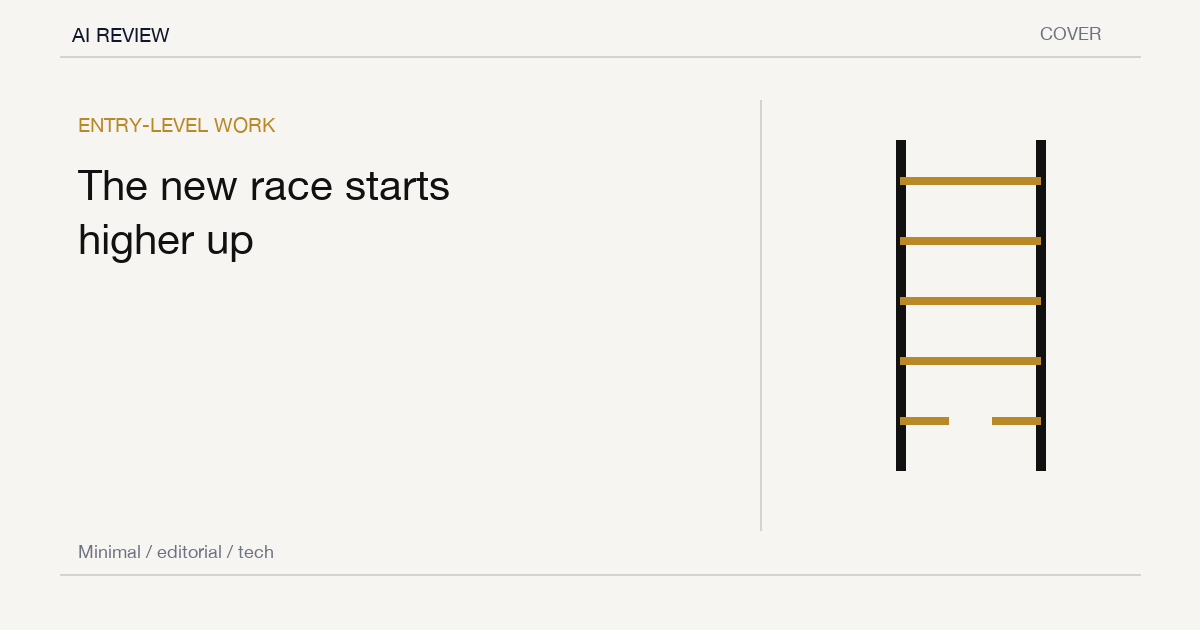
That is why the employment story now looks harsher than the usual "jobs destroyed, jobs created" slogan suggests. AI is not just removing tasks. It is changing what employers think beginner work is worth paying for at all. And once entry-level work is repriced downward, the whole ladder above it starts to wobble...
For years, the start of a white-collar career followed a familiar pattern. New hires handled repetition first. They prepared the first version, gathered the material, wrote the rough copy, cleaned the data, fixed the small bugs, and learned how the organization actually worked by doing the least glamorous tasks at scale.
That repetitive layer is exactly where generative AI is strongest.
In software teams, AI can draft the basic endpoint, test case, or admin panel before a junior developer touches it. In marketing, it can produce the first version of copy, briefs, keyword summaries, and presentation material. In operations and research, it can sort documents, summarize calls, extract themes, and package internal notes. None of that means the work is finished. It does mean the amount of paid beginner labor required to get to a usable first pass is falling.
That changes hiring logic immediately.
A company that once needed several early-career workers to keep repetitive output moving may now decide that a smaller number of experienced workers, armed with AI tools, can cover the same ground. Management does not need AI to replace the whole profession for this to matter. It only needs AI to make junior labor look too expensive for the kind of work juniors used to be hired to do.
This is why the danger is bigger than simple task automation.
Entry-level work has never just been cheap labor. It has also been training infrastructure. It is how people learned quality standards, absorbed business context, saw how decisions were made, and built enough judgment to take on more complicated work later. If AI strips out too much of that layer, the profession may still keep its senior roles while weakening the path that used to produce them.
That is already becoming easier to see across several fields. Employers still want judgment. They still want accountability. They still want people who understand customers, risks, tradeoffs, and internal systems. But they increasingly want those capabilities without paying for as much apprenticeship. They still want the finished worker. They are becoming less willing to fund the making of one.
That is the contradiction at the center of the new skills race.
Young workers are being told to arrive more strategic, more AI-native, and more capable of supervising systems from day one. At the same time, the lower-level work that once helped them become strategic is being automated away. The market is raising the bar while narrowing the route people used to take to clear it.
This is also why the impact feels so uneven. Elite or highly trusted work may remain relatively protected for longer. Companies still need people to validate outputs, handle ambiguity, make judgment calls, manage clients, own failures, and spot when AI is confidently wrong. But ordinary professional work in the middle is under much heavier pressure, especially where the first pass matters more than the perfect one.
That does not mean AI creates no new opportunities. It already is creating demand around workflow design, tool integration, evaluation, prompt and process supervision, automation governance, and people who know how to combine domain expertise with machine output. But those are not one-for-one replacements for the broad entry tracks that used to absorb large numbers of beginners, and they are usually not the kinds of roles a true beginner can walk into easily.
Which is why this shift feels so destabilizing for graduates and early-career workers. The labor market is not only asking what machines can do. It is also asking whether it still wants to pay humans to spend two or three years becoming useful in the old way. More and more employers seem to be answering that question with a quiet no.
The workers most likely to hold value are the ones closest to judgment, trust, responsibility, and problem framing. The workers under the most pressure are the ones whose contribution can be reduced to repeatable digital execution. That may sound harsh, but it is the real line many firms are drawing already.
So the question is no longer whether AI is taking some jobs and creating others. It clearly is. The more disruptive question is what happens when employers stop paying for the bottom rung because software can now do enough of that work cheaply. That is where the new skills race begins, and where a great deal of entry-level work is already being repriced out of existence.