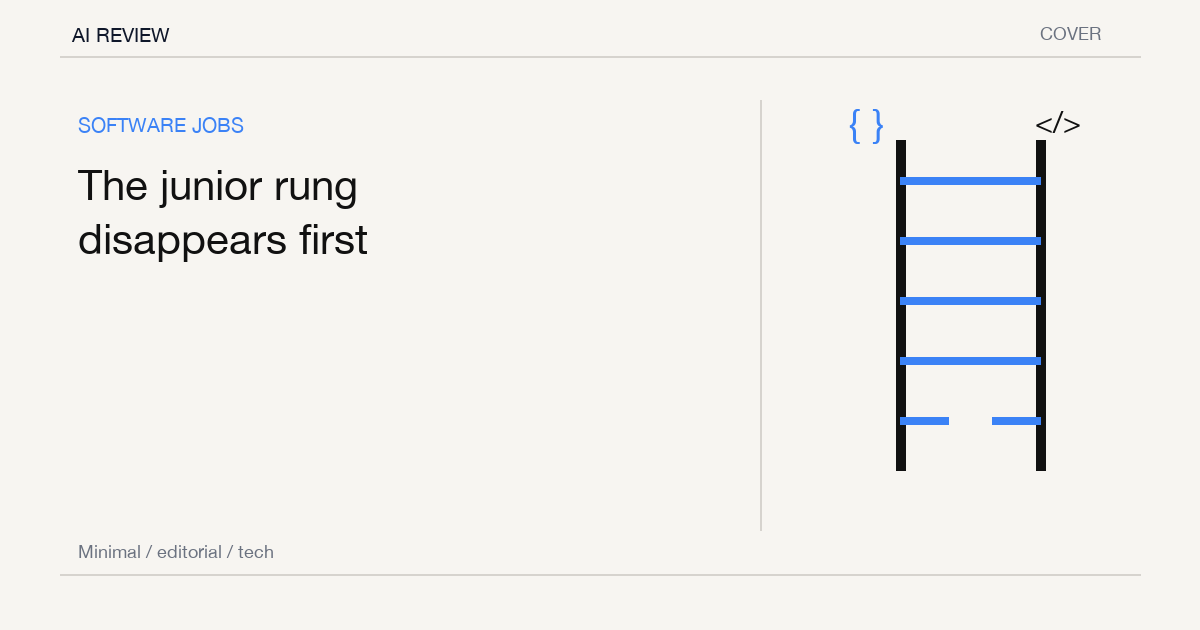
The most immediate AI shock in software is not a machine replacing every engineer on the org chart. It is much more specific than that. Senior developers are using AI to swallow the repetitive implementation work that used to justify bringing junior developers onto a team in the first place.
That is why the real danger may arrive long before "programmers disappear." Software engineering can remain a real profession while the apprenticeship layer underneath it starts to collapse. The work under pressure first is not system architecture. It is the forms, CRUD endpoints, bug tickets, template cleanup, baseline tests, and internal dashboards that once trained future engineers...
That training layer mattered more than the industry often admitted.
For years, junior engineers learned by doing the least glamorous work in the stack. They wired APIs, handled validation logic, built simple interfaces, fixed broken layouts, resolved small defects, cleaned up integration issues, and got used to the discipline of shipping software inside a team. Nobody romanticized that work, but it created real engineers.
AI coding tools now attack exactly that zone.
An experienced developer can prompt out a working scaffold, a batch of endpoints, form logic, documentation, and a first pass of tests in a fraction of the time that similar work used to take. The output still needs review. Security still matters. Edge cases still matter. Authentication, deployment, debugging, and business logic still matter. But the volume of paid beginner work needed to get from idea to working baseline is already shrinking.
That changes staffing math fast.
If a team can now deliver a client dashboard or internal workflow app with fewer people, management does not have to believe in full software automation to cut junior hiring. It only has to believe that the same senior engineer, now using AI, can cover more of the boring implementation layer alone. That is enough to make the junior seat look optional.
That is why the threat to software jobs is so uneven.
The strongest pressure is landing on commodity digital work: admin tools, business portals, routine interfaces, documentation-heavy features, standard back-office systems, and code built from familiar patterns. These were never the most prestigious parts of engineering, but they were an enormous part of how people entered the field.
The profession can survive while that on-ramp weakens.
That is the structural problem hidden beneath all the headlines about whether AI will replace programmers. A field does not need to vanish to become much harder to enter. If companies keep demanding experienced developers while removing the beginner work that produced them, the result is not clean automation. It is a broken pipeline.
This matters because software engineering has long depended on paid apprenticeship disguised as delivery work. New engineers were not hired because they already had top-level architecture judgment. They were hired because there was enough narrow implementation work for them to learn inside. Remove too much of that layer, and the industry risks solving a short-term cost problem by creating a long-term talent problem.
This is already changing what employers want from junior candidates. In weaker hiring markets, companies are no longer impressed by someone who can only write acceptable code slowly from scratch. They increasingly want people who can use AI tools, review generated output, understand how systems fit together, spot silent failure, and contribute with more judgment earlier in their career. In other words, they still want a beginner on paper, but they want someone much closer to a finished engineer in practice.
That is a much higher bar than many previous entry points required. The junior rung is not disappearing because companies suddenly hate beginners. It is disappearing because the boring work that used to justify paying beginners is no longer scarce enough to protect them.
It also means the advice to simply "learn to code" has gone stale. The safer path is no longer to compete with AI on narrow implementation alone. The safer path is to get better at the things AI-generated code still depends on: debugging, system thinking, testing discipline, product tradeoffs, security, reliability, and knowing when generated output looks plausible but should not ship.
That does not mean programming becomes unimportant. If anything, software becomes more central as AI tools spread everywhere. But it may become more polarized. A smaller number of experienced engineers may control larger output, while the broad junior layer that once fed the profession becomes thinner.
So will programmers disappear in five years? Probably not in any complete sense. But that is the wrong benchmark. The more realistic question is whether software engineering will keep offering a wide entry path for new workers. AI may not kill programming. It may do something more damaging to the profession's future: preserve the top while making the lower rung look too cheap, too automatable, and too easy to skip.