The newest language models are smoother than the versions most people used even a year ago. They write better, code faster, search more intelligently, and fit into more workflows. Yet many users keep reaching the same uneasy conclusion after the demo glow fades: the systems feel more polished without feeling much closer to real understanding.
That reaction matters because it gets at the central doubt hanging over the current model boom. If large language models are becoming better at continuing patterns without becoming much better at grasping meaning, then the real AI race may no longer be about the next stronger chatbot. It may be about finding a route beyond systems that can perform intelligence persuasively without necessarily possessing much of it...
The reason the doubt keeps returning is practical, not philosophical.
Modern large language models can already do a remarkable amount of useful work. They draft, summarize, explain, search, translate, and generate code at real scale. But users still run into the same stubborn failure modes: confident factual errors, brittle reasoning, prompt sensitivity, weak long-horizon consistency, and the recurring sense that the system sounds like it understands more than it actually does.
That is why so many people have started describing the current generation of models in contradictory terms. They are useful enough to change work, but still strangely empty. They can imitate knowledge, rearrange knowledge, and package knowledge beautifully. What they do not reliably show is grounded understanding.
This is the core of the ceiling argument. A language model can become commercially indispensable while still being limited in what text prediction alone can achieve. It can look like intelligence at the surface level because surface-level linguistic performance is exactly what it has learned to reproduce.
That is also why older criticisms still feel uncomfortably alive. The system may respond as if it understands, while still leaving open whether anything like meaning exists inside the process. The model handles symbols with extraordinary power. The harder question is whether it knows what those symbols point to, or whether it is simply astonishingly good at continuing the symbolic game.
That distinction matters because current progress often improves the wrapper more than the core uncertainty. Better memory layers, retrieval, tool use, interfaces, and orchestration all make models more useful. They do not automatically settle whether scaling language prediction alone can produce robust understanding.
This is why talk of a post-LLM race keeps resurfacing.
Across the sector, more attention is moving toward systems built around action, simulation, multimodal learning, reinforcement, physical-world interaction, structured memory, and architectures meant to model reality more directly than next-token prediction does. That does not prove language models are finished. It does suggest many serious people no longer believe the current recipe is enough by itself.
The intuition behind that shift is simple. Human intelligence is not built from text alone. It is built from perception, action, memory, trial, failure, and repeated contact with the world. Text records traces of that process. It is not the process.
That is why current models can feel like a thicker and thicker manual without feeling like a mind.
They contain an astonishing amount of accumulated language and can recombine it in ways that look creative, strategic, and informed. But that can still be very different from a system that actually understands the world it is talking about. A bigger manual can produce more convincing answers. It does not automatically produce understanding. A more fluent answer is not the same thing as a more grounded one.
That is the contradiction the market is starting to respond to more honestly than the hype cycle does.
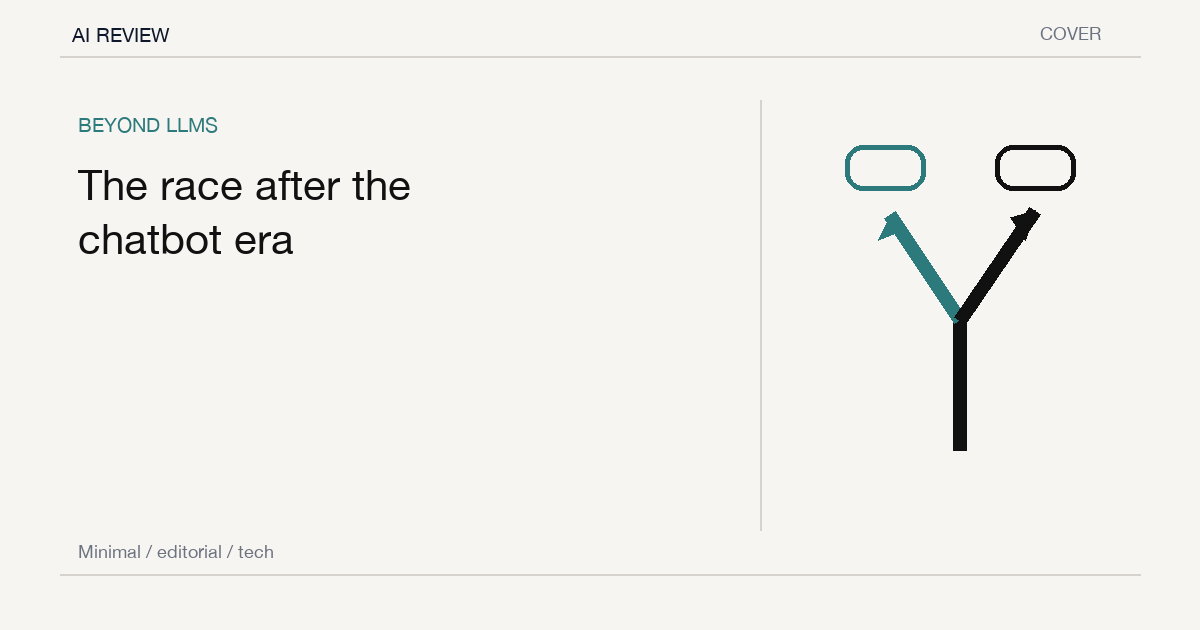
One track of the industry is busy industrializing language models because they already create value. Better wrappers, better memory, better orchestration, better retrieval, better agents, and better interfaces can still build major businesses. The other track is hunting for a different route to intelligence because improving a chatbot is not the same thing as solving intelligence itself.
The field may not be slowing down at all. It may be splitting.
In one branch, language models become a powerful software layer inside search, productivity, coding, customer support, enterprise tooling, and automation. In the other, research and capital keep hunting for a system that can claim stronger grounding, better adaptation, and something closer to genuine understanding.
Large language models are clearly useful. The harder question is whether they are the destination or just the most commercially successful detour on the road to something else. If users keep feeling that current models are getting better without getting deeper, then the industry's next decisive race may be the search for a system that does more than extend language patterns with impossible fluency and call that understanding.