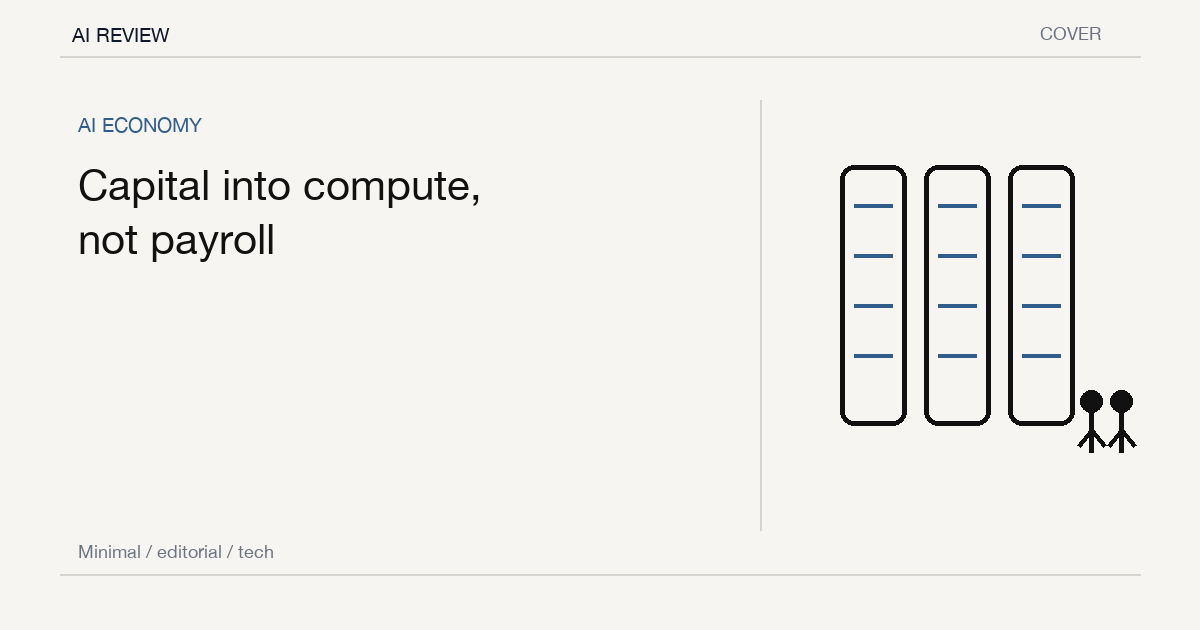
Most technology booms follow a pattern people understand instinctively. Investment rises, companies expand, and hiring spreads across product, sales, operations, support, and the surrounding service economy. The AI boom looks different. The money is real, the spending is huge, and the excitement is obvious. The broad hiring wave is much harder to find.
That mismatch is not a temporary glitch in the cycle. It comes from where the money is going. Unlike earlier software booms, this wave of capital is flowing first into chips, cloud capacity, data centers, cooling, networking, and electricity rather than into large payroll expansion. The boom is massive. The labor absorption is not...
Follow where the money actually lands.
In earlier internet and platform cycles, growth usually translated into people. New products meant more engineers, more marketers, more support staff, more trust and safety work, more sales teams, more operations layers, and often large groups of contractors or adjacent workers keeping the system running. Capital became payroll almost by default.
The AI economy channels money differently.
Training and serving large models requires expensive infrastructure long before it requires a giant workforce. A company can spend enormous sums on GPUs, cloud contracts, networking gear, power, and data-center buildout without creating anything close to the same number of jobs that a labor-heavy platform business once did.
That is the first reason this boom feels socially thinner than its valuations suggest: the money is not flowing first into broad payroll. It is flowing into hardware, compute, and the infrastructure needed to run them. In blunt terms, the money is going to chips, servers, energy, and a small number of high-leverage teams before it goes to ordinary hiring.
Even inside frontier AI firms, output is concentrated. A relatively small number of researchers, infrastructure engineers, and product specialists can build systems that reach millions of users. When one model improvement or orchestration layer can scale across huge usage volume, firms have a strong incentive to pay a narrow group of elite workers very well instead of expanding into broad generalist teams.
The application layer does not fully solve that either.
In theory, AI should create a huge new market for AI products. In practice, AI also makes those products easier to build with fewer people. Small teams can wrap APIs, generate baseline code, automate documentation, compress design work, and ship narrow business tools that once required a much larger org. The same technology being funded as a growth engine is also being used as a headcount compressor.
That is what makes this boom structurally unusual.
AI is not only the object of investment. It is also the mechanism companies use to reduce the labor needed to turn investment into product. In many cases, the money is being spent precisely to make fewer people capable of producing more.
This is why the jobs that do grow tend to be narrower and harder to enter.
There is real demand around infrastructure, applied research, enterprise integration, workflow redesign, model evaluation, safety review, technical consulting, and AI operations. But these are not mass-employment categories on the scale of platform moderation, gig logistics, customer support expansion, or the huge cross-functional hiring waves seen in earlier internet cycles.
Even the labor pools that once looked broad are changing quickly. Data labeling, for example, initially looked like a major employment engine around AI. But as models improve, synthetic data grows, and evaluation tasks become more specialized, the low-barrier version of that work becomes less durable.
That is why counting new AI job titles misses the core problem.
The more important question is net labor demand. How many workers are actually being added? How many roles are being compressed? How many people are never hired because the first pass is now done by software? How many tasks are being repriced before they ever become job openings?
There is still an optimistic case. AI may lower the barrier to entrepreneurship, letting smaller teams and even individuals build useful businesses that once required larger companies. But even that optimistic scenario points back to the same underlying fact: value creation may broaden while payroll narrows.
That is why the AI boom is creating so much capital with so little visible employment. The money is not missing. It is being concentrated in chips, compute, energy, and a relatively small number of highly leveraged teams. That is the uncomfortable logic of this cycle: the capital is real, but a large share of it is being deployed in ways that do not turn into broad payroll. Put more bluntly, a lot of the money is not going to workers because the point of the spending is to need fewer workers.